Infrastructure & Messaging• 40 Min
Event-Driven Architecture & Scaling with Apache Kafka
HARD
System Architecture DiagramInteractive Zoom
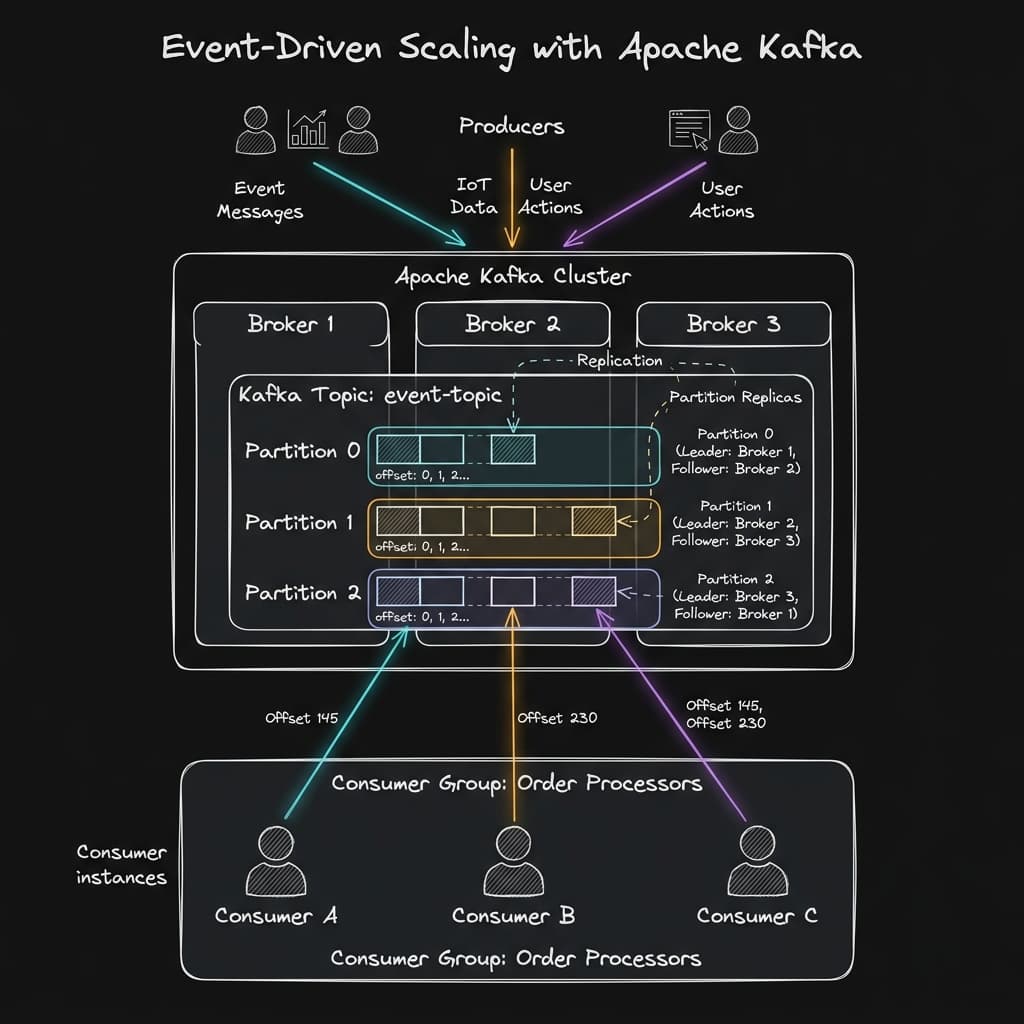
Event-Driven Architecture & Scaling with Apache Kafka
Apache Kafka is an append-only distributed event log capable of processing millions of events per second with high throughput, zero data loss, and sub-millisecond latencies.
1. Core Architecture: Topics, Partitions & Brokers
code
                                TOPIC: user-clicks
    +---------------------------------------------------------------+
    | Partition 0: [Offset 0] -> [Offset 1] -> [Offset 2] -> [Offset 3]
    +---------------------------------------------------------------+
    | Partition 1: [Offset 0] -> [Offset 1] -> [Offset 2] -> [Offset 3]
    +---------------------------------------------------------------+
    | Partition 2: [Offset 0] -> [Offset 1] -> [Offset 2] -> [Offset 3]
+---------------------------------------------------------------+- Partition as the Unit of Scalability: An individual partition cannot be split across brokers. Ordering is strictly guaranteed only within a single partition, not across partitions.
- Partition Key Routing: Producers compute
hash(key) % N_partitions(MurmurHash2). All messages for a givenuser_idland on the exact same partition, guaranteeing chronological ordering.
2. Consumer Groups & Dynamic Rebalancing
- Consumers belong to a Consumer Group. Each partition in a topic is consumed by exactly one consumer within that group.
- If a consumer dies, the Group Coordinator triggers a Rebalance: unassigned partitions are reassigned to surviving consumers, with offsets resumed from the internal
__consumer_offsetstopic.
3. Durability & Replication Mechanics (acks=all)
- In-Sync Replicas (ISR): The set of replica nodes that have fully caught up with the partition leader.
- Producer Acknowledgments:
acks=0: Fire-and-forget (fastest, high risk of loss).acks=1: Acknowledged once the partition leader writes to disk.acks=all(-1): Acknowledged only after all in-sync replicas write the message. Guarantees zero data loss even if the leader node suffers catastrophic hardware failure.
Key Architecture Trade-Offs & Decision Matrix
| Dimension | Option A: Asynchronous / Decoupled | Option B: Synchronous RPC | Trade-off & Recommendation |
|---|---|---|---|
| Communication Pattern | Message Queues (Kafka / SQS) | Direct gRPC / REST Calls | Message queues prevent cascading failures and provide backpressure buffering. |
| Failure Handling | Dead Letter Queue (DLQ) with Exponential Backoff | Immediate Circuit Breaker trip | DLQ preserves unparseable messages for manual operational inspection. |
| Ordering Guarantees | Partition-level Strict FIFO | Unordered Parallel Execution | Partition-key routing guarantees chronological order per entity without global lock contention. |
Prerequisites
- Distributed Commit Log Concepts
Kafka Partition Broker
Simulate how a Kafka producer hashes message keys (e.g. `user_id`) to assign events to partitions, maintaining ordering per partition.
Broker Partitions
Part 0
empty
Part 1
empty
Part 2
empty